
Our Sticky Love
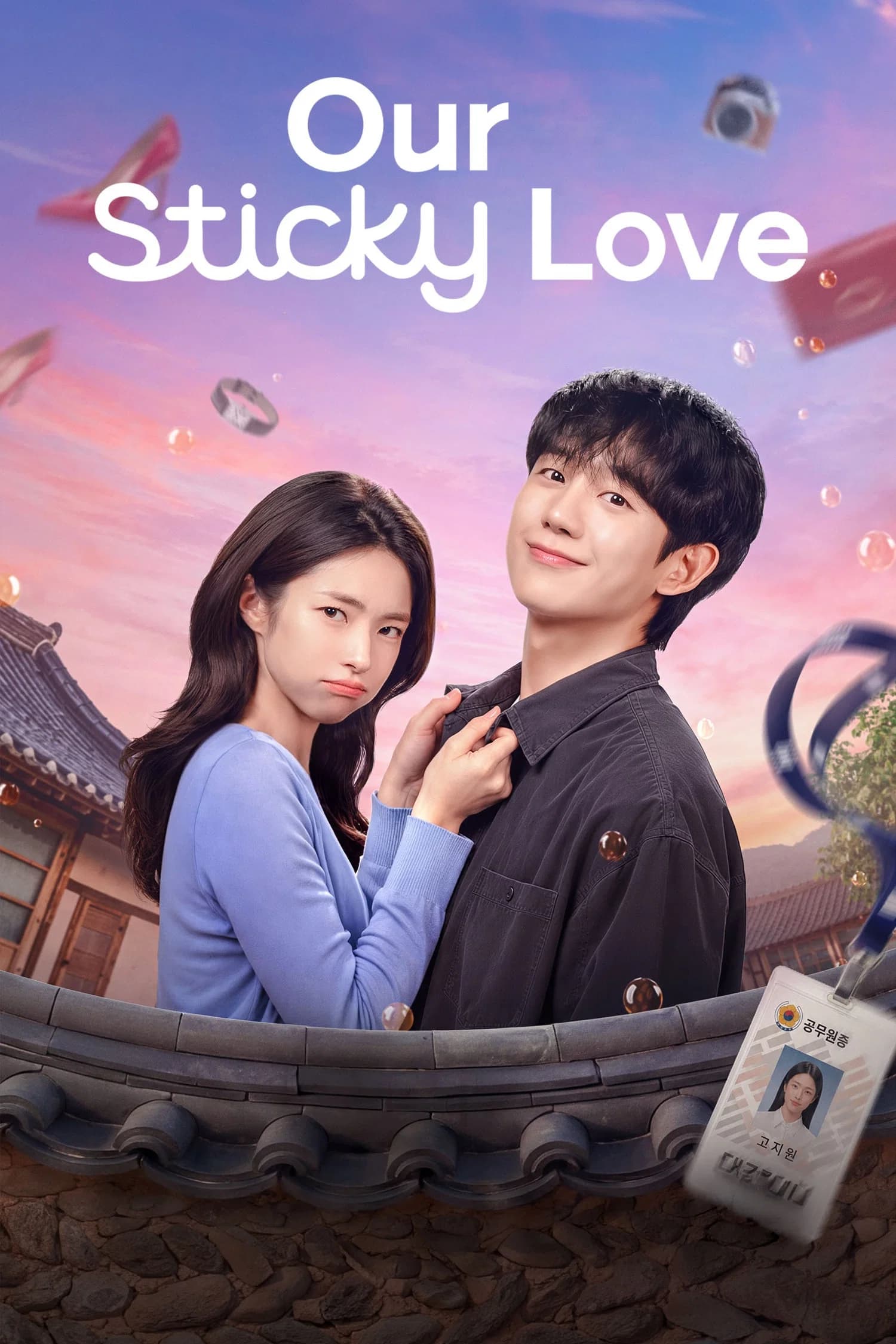
Our Sticky Love
While Our Sticky Love has taken the globe by storm—climbing to the number two spot on Netflix's worldwide television charts and hitting number one in eighteen countries—its domestic promotional tour recently came to a screeching halt. The reason lies not in the series itself, but in a real-world historical controversy surrounding lead actress Ha Young. Following a television appearance where she proudly mentioned her great-grandfather's pioneering medical career, South Korean netizens uncovered his alleged pro-Japanese ties during the colonial period, a deeply sensitive subject that quickly ignited public outrage. The backlash was swift and severe, forcing the cancellation of major promotional events, including highly anticipated press interviews with her co-star, Jung Hae-in. Yet, while this historical scandal dominates domestic headlines and casts a shadow over the show's local marketing, international audiences remain entirely captivated by the fictional world unfolding on screen.
Stripped of its off-screen turbulence, Our Sticky Love offers a masterclass in genre-blending that justifies its massive viewership. The twelve-episode limited series opens with a gripping, disorienting hook: ambitious Seoul prosecutor Go Eun-sae wakes up in a rural clinic with severe amnesia. She has no memory of her name, her prestigious career, or how she ended up in the countryside. Her confusion only deepens when Jang Tae-ha, a scruffy, enigmatic boxing coach, arrives at her bedside and insists that he is her devoted boyfriend. The premise immediately establishes a compelling central tension. When you cannot remember the person standing in front of you, how can you trust that their affection is genuine?
From this setup, the drama leans heavily into a chaotic, opposites-attract romantic comedy. Tae-ha is rough around the edges, unpolished, and far from the sophisticated ideal Eun-sae assumes she would have chosen for herself. Their resulting dynamic is built on suspicion, awkward cohabitation, and constant bickering. Rather than presenting a fully formed romance, the series asks the audience to watch two people construct a relationship from scratch, navigating misunderstandings and slowly building trust. Eun-sae's innate prosecutorial instincts prevent her from blindly accepting Tae-ha's story, and she essentially becomes an investigator in her own life, analyzing his every move to determine if he is a reliable narrator of her past.
But Our Sticky Love is not merely a lighthearted rom-com; it harbors a much darker, high-stakes core. Eun-sae's amnesia was not the result of a random accident. Before losing her memory, she was a fierce anti-corruption prosecutor on the verge of taking down a dangerous criminal syndicate. The man she was investigating, the ruthless crime boss and company chairman Baek Sang-gil, is actively hunting her down to finish the job. This looming threat injects a palpable sense of noir and suspense into the narrative. The show seamlessly pivots from the sunny, comedic misunderstandings of a fake relationship to the life-or-death stakes of a mob thriller, keeping viewers constantly off balance.
At the center of this tonal tightrope is Jung Hae-in, who delivers one of the most unexpected performances of his career. Known for playing polished, soft-spoken romantic leads, Jung sheds his usual image to portray Jang Tae-ha. Tae-ha is a man carrying the heavy burden of a violent past; he is a former gangster and enforcer for Baek Sang-gil's syndicate who was originally sent to eliminate Eun-sae. Unable to go through with the hit and desperate to protect her from his boss, he fabricates the boyfriend lie as a desperate shield. Jung masterfully captures Tae-ha's internal conflict, balancing the physical intimidation of a seasoned fighter with the quiet, desperate tenderness of a man trying to save the woman he loves—even if that love is built on a massive deception.
Opposite him, Ha Young shines as a remarkably proactive heroine. It is notoriously difficult to play an amnesiac character without coming across as passive or helpless, but Ha Young infuses Go Eun-sae with a sharp, analytical edge. Even without her memories, her personality remains intact. She is fiercely intelligent, deeply skeptical, and relentlessly curious. As she navigates the unfamiliar terrain of her new life, she is forced into a profound existential crisis. Eun-sae must decide which fragments of her former, ruthless self are worth recovering, and whether the softer, more vulnerable person she is becoming alongside Tae-ha is actually a better version of herself. Her performance anchors the show's emotional weight, making her journey of self-discovery just as compelling as the romance.
The drama's distinctive setting plays a crucial role in balancing its disparate genres. Instead of confining the action to the sleek, cold corporate offices of Seoul, the story relocates to the vibrant, eccentric Gujin Taffy Village. This rural community, famous for its traditional Korean taffy shops, provides a nostalgic and cozy backdrop that sharply contrasts with the bloody, cutthroat reality of Eun-sae's past. The village is a character in its own right, offering a warm, protective enclave that isolates the main couple from the dangers of the city while simultaneously forcing them into close, inescapable proximity.
This setting also gives the series its clever, multifaceted title. In Korean, the original title Ireon Yeot-gateun Sarang translates literally to This Love Is Like Yeot. While yeot refers to the traditional, sticky sweet taffy produced in the village, it doubles as a common Korean slang term roughly equivalent to a harsh profanity, essentially describing a thoroughly messed-up situation. As lead actor Jung Hae-in noted during the show's press conference, the title perfectly captures the show's essence: a love story that is undeniably sweet and binding, but born out of a chaotic, messy, and incredibly dangerous lie. It is a brilliant linguistic nod to the show's central metaphor of a relationship that binds two people together through sticky, inescapable circumstances.
Bolstering the leads is a formidable supporting cast that bridges the gap between the show's terrifying noir elements and its small-town charm. Heo Sung-tae is chilling as Baek Sang-gil, bringing a sophisticated, ruthless menace to the role of the crime boss hunting Eun-sae. On the opposite end of the spectrum, the village is populated by a beloved roster of veteran character actors. Icons like Kim Young-ok, Jeon Bae-soo, Seo Jeong-yeon, and Cha Chung-hwa portray the eccentric local residents. Their comedic timing and meddlesome but well-meaning personalities provide essential comic relief, creating a found-family dynamic that gives Eun-sae a reason to fight for her new life.
Director Kim Jang-han and writer Mo Ji-hye deserve immense credit for the tight pacing of the twelve-episode limited series. K-dramas that attempt to blend romantic comedy with murder and organized crime often suffer from tonal whiplash, but Our Sticky Love manages the transition with grace. The comedy never undermines the genuine threat posed by the criminal syndicate, and the suspense never entirely eclipses the sweetness of the central romance. By condensing the narrative into twelve hours rather than the traditional sixteen, the creators ensure that the mystery unfolds briskly, with each episode peeling back a new layer of Tae-ha's deception and Eun-sae's forgotten history.
For viewers looking to find their next binge-watch, this series checks an impressive number of boxes. It is a perfect fit for fans of the classic amnesia trope, as seen in global hits like the Hollywood film Overboard, but it modernizes the concept with a gripping thriller subplot. If you enjoyed the small-town charm mixed with high-stakes danger found in When the Camellia Blooms, or the enemies-to-lovers tension of Crash Landing on You, the tonal landscape of Gujin Taffy Village will feel delightfully familiar. The core appeal lies in the following elements:
- A Gripping Fake-Relationship Dynamic: The fake-dating-turned-real-love narrative adds a layer of deliciously agonizing tension, as audiences wait for the inevitable moment when Eun-sae discovers the massive lie upon which her new life is built.
- High-Stakes Crime Noir: A legitimate, suspenseful threat from a ruthless criminal syndicate keeps the pacing fast and the stakes incredibly high.
- Strong Character Development: Neither lead is a static archetype. Both Eun-sae and Tae-ha undergo profound psychological and moral transformations.
- Rich Community Atmosphere: The eccentric villagers provide endless comedy and a heartwarming found-family aesthetic.
Ultimately, Our Sticky Love succeeds because it uses its wild premise to ask universally resonant questions about identity and redemption. Can you truly love someone if you met them under false pretenses? Is it possible to outrun the sins of your past, or will they always catch up to you? Despite the undeniable noise and controversy surrounding its cast off-screen, the drama itself remains a beautifully crafted, emotionally satisfying journey. With its perfect blend of romantic chemistry, laugh-out-loud village comedy, and pulse-pounding noir suspense, it stands out as one of the most distinctive and memorable television offerings of 2026. The series is now streaming globally on Netflix.
Comments
Login to write comment / Кино үзэхийн тулд заавал нэвтрэх хэрэгтэй
Log inNo comments yet. Be the first to write one!