
Notes from the Last Row
Notes from the Last Row
There is an intoxicating, often dangerous power in playing god with other people's lives on the page. For most writers, this manipulation is confined safely within the boundaries of pure imagination. But what happens when a storyteller begins using real, breathing people as his raw material—and his mentor becomes too addicted to the narrative to make him stop? This deeply unsettling ethical dilemma forms the beating heart of Notes from the Last Row, a brilliantly suffocating psychological thriller that strips away the familiar tropes of Korean television to deliver a masterclass in suspense, manipulation, and obsessive ambition.
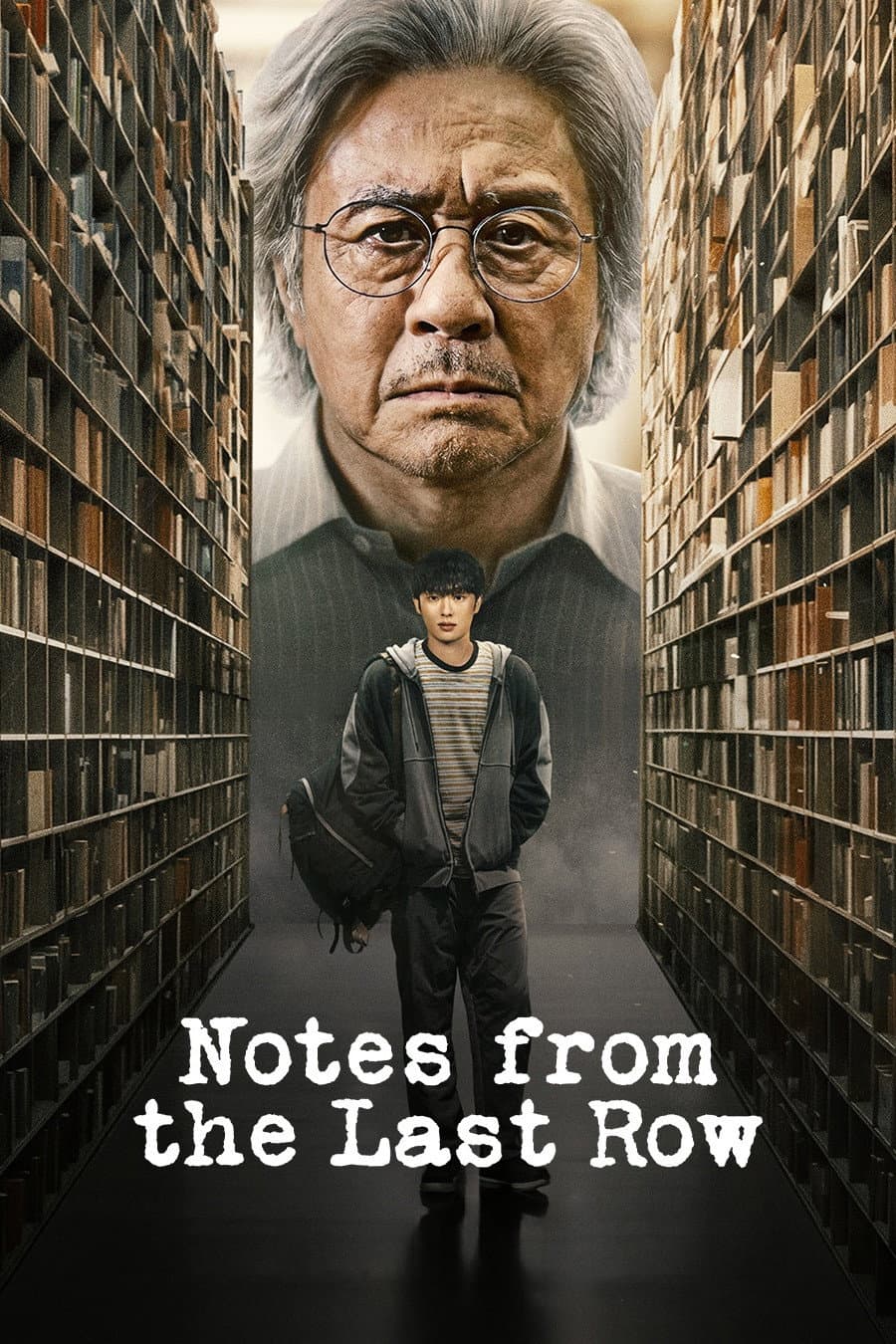
At first glance, the setup masquerades as a traditional, albeit melancholic, tale of mentorship. We are introduced to Heo Mun-oh, a prestigious university professor of Korean literature who has spent years rotting from the inside out. Harboring deep-seated insecurities after his own career as a novelist stalled out decades ago, Mun-oh is trapped in a life of quiet resentment. He despises his uninspired students, envies his successful peers, and suffocates under the weight of his own defeat. His bitter stagnation is interrupted by Lee Kang, an unassuming engineering student who perpetually occupies the furthest seat in the lecture hall. When Kang submits a breathtakingly perceptive piece of creative writing, Mun-oh is instantly hypnotized. The professor offers private tutelage, dreaming of molding a prodigy who might finally validate his own literary worth, but unwittingly opens the door to a psychological labyrinth.
Given the visceral, almost voyeuristic realism of the series, viewers might naturally wonder if the unsettling events of Notes from the Last Row are rooted in a true story. They are not, but their origins are firmly anchored in acclaimed international theater. The drama is a meticulous reimagining of the 2006 Spanish play El chico de la última fila (The Boy in the Last Row) by renowned playwright Juan Mayorga. By transplanting Mayorga’s European stage narrative into the hyper-competitive, status-obsessed landscape of modern South Korea, writer Jang Myung-woo and director Kim Kyu-tae have crafted an atmosphere that feels remarkably fresh. It retains the intimate, dialogue-driven claustrophobia of a stage play while expanding its scope into a sweeping television event.
Anchoring this descent into madness is a titanic performance by veteran actor Choi Min-sik as Heo Mun-oh. Choi, long celebrated for his explosive intensity in cinema, pivots here to portray a man whose volatility is entirely internalized. His Mun-oh is a tragic, pathetic, yet deeply human figure—a mixture of intellectual arrogance and crippling jealousy. When he reads Kang's work, it reignites a dormant spark within him, but that spark quickly metastasizes into a toxic obsession. Choi masterfully captures the frantic, almost boyish eagerness of a failed artist living vicariously through his student, entirely blind to the moral boundaries they are rapidly crossing.
During the production of the series, whispers circulated in the Korean entertainment press that Choi Min-sik had personally bypassed standard casting protocols to handpick his young co-star. Choi later cleared the air during a press conference with his trademark self-deprecating humor, clarifying that he simply attended the auditions to observe the talent pool. According to the veteran actor, out of all the hopefuls, Choi Hyun-wook was the only one bold enough to approach him and casually offer to buy him a meal. It was a quiet, confident audacity that perfectly mirrored the invasive yet disarming nature of his on-screen character. That same undeniable, magnetic friction translates flawlessly to the screen.
As the titular boy in the back of the classroom, Choi Hyun-wook delivers a chillingly detached performance that serves as the perfect foil to his mentor’s unraveling. Lee Kang is a mystery wrapped in a polite, unassuming smile. He does not invent fictional worlds; he infiltrates real ones. For his assignments, Kang begins observing a wealthy classmate, embedding himself in the boy's home and documenting the family's intimate, often ugly realities. He turns their private lives into his personal serialized fiction. What starts as innocent observation quickly bleeds into invasive voyeurism, and eventually, active orchestration. Kang isn't just watching the story unfold—he begins pulling the strings to see how his characters will dance.
This is exactly where Notes from the Last Row pivots from a slow-burn drama into a gripping psychological thriller. The power dynamic between teacher and student constantly subverts expectations. Mun-oh is supposed to be the authority figure, the ethical guide who should immediately shut down Kang's invasive writing. But Mun-oh is too addicted to the prose. Like a reader desperate for the next chapter of a serialized novel, the professor overlooks the blatant invasion of privacy, demanding more pages, more secrets, and more conflict. Kang, keenly aware of his professor’s growing addiction, begins to weaponize his talent, manipulating not just the subjects of his stories, but Mun-oh himself.
The stakes are astronomically raised when the subjects of Kang's fiction are revealed to be deeply connected to Mun-oh's own buried traumas. Kang’s narrative target is the family of Kim Se-yun, whose father happens to be Kim Su-hun—played with an effortless, gratingly comfortable charisma by Huh Joon-ho. Su-hun is everything Mun-oh is not: a bestselling, critically acclaimed author who has been churning out hits since their university days. To twist the knife further, Su-hun is married to Ahn Eun-joo (Kim Yunjin), the elegant woman whom Mun-oh has harbored a pathetic, unrequited obsession with for decades. As Kang's writing systematically exposes the hidden fractures in Su-hun and Eun-joo's seemingly perfect domestic life, Mun-oh’s voyeurism takes on a vindictive edge. He isn't just reading a gripping narrative anymore; he is gleefully consuming the destruction of the man he despises most.
Caught in the crossfire of this literary warfare is Mun-oh’s own wife, Jo Hyeon-suk, portrayed with grounded resilience by Jin Kyung. As a therapist, Hyeon-suk provides a stark contrast to her husband’s spiraling delusions. She represents the tether to reality that Mun-oh is so desperate to sever, and her presence highlights the collateral damage caused by his obsession. The domestic tension in Mun-oh’s own home serves as a brilliant counterweight to the drama unfolding in Kang’s manuscripts. The exceptional supporting cast ensures that the narrative never feels isolated; every character is a vital, bleeding organ in the show's anatomy.
Under the meticulous direction of Kim Kyu-tae—a filmmaker known for his nuanced exploration of the human psyche—the series utilizes its visual language to blur the increasingly thin line between observation and reality. The cinematography mirrors the act of reading itself. Sometimes we are intimately close to the characters, hearing their frantic breaths, and other times we are watching them from afar, through windows and half-open doorways, making the audience complicit in Kang’s voyeurism. There are no explosive car chases or supernatural elements to rely on here; the terror is purely psychological. The thrill comes from the slow realization of how easily a life can be ruined by a well-crafted sentence.
Ultimately, the series asks a profound question about the nature of art and accountability: Can a writer ever truly observe a subject without altering it? As Kang crosses the line from a passive fly-on-the-wall to an active saboteur, the show forces the audience to confront their own complicity as viewers. We, too, are eagerly waiting for the next episode, hungry for the next dramatic reveal, just as Mun-oh is hungry for Kang’s next draft. This meta-textual layer elevates the script from a simple mystery into a cerebral mind game that rewards attentive viewing.
For fans of conventional, romance-heavy Korean dramas, this series will feel like a bucket of ice water. Notes from the Last Row is remarkably dark, trading superficial aesthetics for bruising psychological depth. It is tailor-made for audiences who gravitate toward character-driven suspense, moral ambiguity, and stories that refuse to hand-hold their viewers. If you enjoy tense, claustrophobic thrillers that prioritize mind games and the quiet devastation of human flaws over standard action sequences, this is an absolute must-watch.
The decision to contain this sprawling psychological warfare within a tight, six-episode limited run is one of the show’s greatest strengths. There is no room for filler subplots or narrative meandering. Every scene serves a purpose, steadily tightening the noose around its characters until the tension becomes nearly unbearable. From the moment Kang hands in his first assignment to the inevitable, explosive consequences of his final draft, the pacing is absolutely relentless.
Notes from the Last Row is a haunting examination of the intersection between art and malice. It proves that the most dangerous weapon a person can wield is not a blade, but the ability to tell a compelling story. Anchored by two generation-spanning powerhouse performances and a script that cuts directly to the bone, this series stands as a bold, unconventional triumph in the landscape of streaming thrillers. It will leave you deeply unsettled, questioning the motives of every narrator, and utterly incapable of looking away until the final page is turned.
Comments
Login to write comment / Кино үзэхийн тулд заавал нэвтрэх хэрэгтэй
Log inNo comments yet. Be the first to write one!